Slade's Morgue:
Headhunter


The Headhunter is loose on the streets of Vancouver.
The victims are everywhere - floating in the Fraser River, buried in a shallow grave, nailed to an Indian totem pole on the university campus. All are women. All are headless.
Then the photographs arrive. Carefully posed shots of the women's heads stuck on poles.
The Mounties of Special X are up against a unique brand of killer. A killer whose sexual psychosis stretches back through Ecuador's steaming jungle and a scream-filled New Orleans dungeon to a dead-of-winter manhunt in the Rocky Mountains a century ago.
HEADHUNTER is Michael Slade's first psycho-thriller. The origin of an author's first novel is often the most telling, because it reveals what compelled the author to take up writing.
Sometime in his boyhood, Slade encountered a horror story about the French Revolution.

During the Reign of Terror in 1793, thousands went to the guillotine, as many as 50 a day. A severed human head can survive for up to a minute on the blood-oxygen supply in its brain. Executioners would watch for still-conscious heads, and taunt them by showing the victims their headless bodies. A French scientist about to go to "the National Razor" told his student to count the number of blinks his severed head made to learn how long it lived on. The head blinked 20 times.

Early on in Slade's career as a criminal lawyer, a killing occurred in a local skid road rooming house full of drunks and junkies. Two men were vying for the affection of a single woman. One night, she answered a knock on her door. There stood one of her suitors, with a romantic gift. "I love you," he said, offering her a plate containing the head of the other man.
Cops and criminal lawyers develop gallows humor. It's a coping mechanism to deal with the horrors of murder.
In the Bible (Mark 6:14-29), Salome asks to have the head of John the Baptist delivered to her on a plate.

The head of John the Baptist, by Virgil Finlay
Vancouver cops and lawyers dubbed the skid road killing "the John the Baptist murder."
Of all the horrific images absorbed in Slade's boyhood, none had a more jarring effect than this grisly cover drawn by Stanley Borack for MALE magazine in May 1956. Slade was 8 when he got spellbound by "Raid of the Jivaro Headhunters."

To grasp the bizarreness in what happened, you need to know Slade's dad.
Jack Clarke was born in Montreal in 1921. He spent his teenage years on the south coast of England as a scholarship student attending the Southampton School of Art. After winning 1st Prize in Pictorial Design, Jack was headhunted as a commercial artist by Associated Screen News in Montreal.
In September 1940, at the height of the Battle of Britain, when England stood alone against Hitler's Nazi onslaught, Jack volunteered to fly as a Canadian pilot attached to Britain's Royal Air Force. Sent to Scotland, he was trained and crewed-up as the captain of a heavy bomber. Since "Jack" came over the radio like a crack of static, he was nicknamed "Johnny."

Flight Lieutenant Jack "Johnny" Clarke
Between October 1941 and December 1942, Jack flew 47 combat missions. RAF Bomber Command attacked by night. Jack's first raid was on Nuremberg, the rally center of Nazi ideals.

OUTWARD BOUND by Roy Nockolds

Jack in combat
In the Battle of the Atlantic, Jack was a U-boat destroyer, and he flew in the raid that got the Gneisenau, one of Hitler's 4 big battleships.
In what marked the turning point of the air war, Jack partook in all the Thousand Bomber Raids: Cologne, Essen, Bremen.
Sent to North Africa for the Desert War, Jack fought Rommel's Afrika Korps, and he flew in the Battle of El Alamein, the turning point of the ground war.
Then, back in Britain as a deputy Flight Commander, Jack trained the heavy bomber crews that struck Hitler's V-2 rocket factory in August 1943. That setback in production ensured Nazi missiles weren't ready to rain down on D-Day invasion forces the following year.

RAF Bomber Command suffered the highest casualty rate of any Allied unit in the Second World War. Only 27 out of every 100 airmen completed a tour of 30 combat missions...and Jack survived 47.
In January 1945, the air force loaned him as a pilot to Trans-Canada Air Lines, now Air Canada. There, he met and married Vivian Murdoch, a registered nurse who had worked with mental patients in a remote West Coast Indian village, and then had taken to the air for far-flung adventures.

Vivian Clarke
In May 1947, Slade was born in Lethbridge, Alberta. He was named Jay (for Jack), and that October, his parents moved to Winnipeg, Manitoba.

Slade and his Mom
The Clarkes settled in Wildwood Park, an outlying neighborhood surrounded by the Red River, in the suburb of Fort Garry, the launching point for the Great March West by the North-West Mounted Police - now the Royal Canadian Mounted Police - in 1874.

The crosshairs mark the spot where - six years later - Slade would suffer his break with reality.
When Slade was a boy in the 1950s, there were still unexplored corners of the world. And nothing gave rise to the heebie-jeebies quite like Jivaro headhunters in the Amazon jungle.
Fall into Jivaro hands and your head would end up like this.

Headhunters stalked the movies.

Headhunters haunted the comics.

Headhunters fronted the men's magazines.


Trouble waiting to happen.

Jack came home from the Second World War with a chest full of medals and a reputation as the go-to-guy if you were in trouble.
For example: a neighbor returned from ground combat with post traumatic stress disorder, a hair trigger temper, and a German Luger seized as a trophy. He warned his young son on pain of a whipping never to touch the pistol.
That was an era when every boy played "cowboys & Indians" and "guns." While his dad was at work, the boy fetched the Luger - which was loaded - and blew off his finger.
When the volatile vet learned of the mishap on the phone, he went berserk. Afraid her husband might kill the boy, the frantic mother called Jack.
On arriving home, the soldier burst in with his belt off and the buckle hanging down to find his terrified son hiding behind Slade's dad. Jack told the man he was to blame for leaving a loaded gun around. The boy had suffered enough from that folly, and for the father to get at his son, he'd have to go through Jack.
In the end, Slade's dad talked the man down.
No boy could have a better dad than Jack. He put as much effort into fatherhood as he did everything else.
When Slade was 3, Santa Claus brought him "The Countryside."

See the planes at the airport? The knotholes sunk as ponds? The tractor and the animals on the farm? The cash crop in $ signs? The school bell ringing as the kids run to class? And how the dog follows them along the street?
Later, Jack took Slade up to see the real thing. From the copilot's seat of a cockpit, the horizon stretches forever.
In 1950, the Red River jumped its banks. The Clarkes lost everything in the Winnipeg Flood.

Undaunted, Jack rolled up his sleeves, and Slade watched him rebuild their home and lives from scratch.
In winter, Jack would freeze the yard so his son had a skating rink. Or bank and freeze the snow into a roller-coaster slide. Or burrow and freeze through 5-foot-high drifts to make ice caves.
Come summer, he hammered together the fastest soapbox racer. And a 2-story bunker-like fort with a periscope and secret hiding places, complete with an inkwell full of lemon juice for invisible writing. Applying heat to paper turned the juice brown to reveal the message.
Early on, Jack taught Slade how to read, and how to construct pictures to conjure a fantasy world.

When a Wildwood school roped Jack in to build stage sets for its pageant, the artist taught his son how to make a fantasy world materialize.
Before long, Slade could slip in and out of what he now calls "The Zone" at will.

Off in "The Zone"
Jack had an aura about him. He seemed invincible. In RAF jargon, Jack had escaped "the night his number came up." To be around Slade's dad was to feel safe.
But on the day Slade needed Jack the most, his father wasn't around.

Have you ever been attacked by a mad dog? Not a barking, snarling, baring of teeth, but an all-out attack where a rabid beast sinks its fangs and tries to tear you apart?
Winnipeg in winter is bitterly cold. After the snow melts, the cold hangs on, so Slade was dressed in longjohns, jeans, and a snowsuit like this.

Jack was away on a cross-country flight when his bundled-up son took this tricycle for a spin along this central walkway of Wildwood's H Section.

Suddenly, the mad dog ran out from between the houses and clamped onto Slade's leg. The boy let out a scream and tried to kick his attacker away. Refusing to let go, the beast ripped the leg of the snowsuit by gnashing with its fangs.
By luck, Jack had recently given his son a dog, named for the new aircraft that would later replace propeller planes.

Jet was a Shetland collie (now called a Shetland sheepdog), a miniature breed that is highly protective. On hearing Slade scream, Jet came dashing from the far side of their home.
The dogfight was a mismatch. Jet was smaller, but his counterattack gave Slade an opening to climb up and stand on the trike's seat. Each time the mad beast shook off the Sheltie, it would rip into Slade's leg, only to have Jet recover and pounce again. Soon, neighbors responded with whatever weapons were at hand.
The doctor summoned told Slade's mom that if not for his layered clothing, the boy would have lost his leg. The fangs shredded the snowsuit, but failed to tatter his jeans.
If not for Jet, Slade might have lost his life.
The mad dog's name was Sparky. The police put him down. Decades later when Slade wrote his first thriller, he gave the name Sparky to the psychotic killer that lurks in the Headhunter's mind.
Jack came home from flying to find his son hugging Jet. Fetching a sheet from the looseleaf binder Slade used for drawing, his dad drew a quick sketch of the "hero of the day." See the binder holes down the left edge? And the wound above Jet's eye?

Trouble waiting to happen. The crosshairs below mark where 6-year-old Slade's break with reality began. But first, the lay of the land.

Manchester Park was a thicket of forest in central Wildwood, halfway between Slade's home in H Section and his Grade 1 school on Point Road.
In the 1950s, 2 paths snaked through the woods. The Ghosty Path was bisected by a spring. If you were lucky, the Huck Finn raft would be on your side, and you could pole across. The Witchy Path ran through a clearing with several totem poles.
The poles were amateur versions of these:

One day, as Slade walked the Witchy Path to school, the Thunderbird, Flying Bird, and Big Mouth monsters on the totem poles began flapping their wings, snapping their beaks, and grinding their teeth.
When Slade got to class, he threw up on the floor. During his walk through the woods, he'd come down with a dangerous flu that spiked his temperature so high that feverish hallucinations had brought the totem poles to life.
His teacher gave him money to go home. While Slade sat on the curb waiting for a bus, his dad drove past from an overnight flight.
They stopped at the drugstore for flu medications, and because Slade would be home sick in bed, Jack handed him a dollar to buy 10 comics.
As the hallucinating boy weaved by the magazine racks, he saw an image akin to this and got sucked into The Zone.

Caught in the grip of the flu, Slade couldn't pull himself out.
He was trapped inside the horror, and Jivaro headhunters were about to hack off his head.
Jack's hand came over Slade's shoulder and turned the cover facedown. "Does that picture frighten you?" he asked. "It's meant to frighten grownup men like me."
In the summer of 1955, the Clarkes moved west to Vancouver, British Columbia. The following spring, Jack and his son entered a West Coast drugstore. While his dad spoke to the pharmacist, Slade crossed to the side-by-side racks for comics and magazines. That's where he saw Stanley Borack's cover.

This time, the 8-year-old didn't have the flu, but like post-hypnotic suggestion, the Wildwood hook reeled him in. Again, Slade got yanked into The Zone, and couldn't pull back. He was trapped inside the cover, with the headhunter's bloody machete coming for him.
Then, as before, Jack turned the horror facedown and said, "Out of sight, out of mind."
Six months later, on December 9, 1956, Jack's number - in Bomber Command jargon - finally came up.

Jack wasn't on call to fly that night, but he switched trips with another pilot so his friend could stay home for his son's birthday.
The Cascade Mountains 50 miles east of Vancouver are called "the Graveyard of the Air." Wind roars in from the Pacific and slams into them. Air currents change in the blink of an eye. Downdrafts can mean there's suddenly no air under a plane's wings.

While climbing over the Cascade Mountains, Jack's flight ran into a deadly winter storm. Icing got so heavy that one of the DC-4 North Star's propeller engines burst into flames. Unable to maintain altitude, Jack turned back to Vancouver. While flying blind toward a faulty guidance beacon, the plane vanished from radar.
Search planes scrambled, but the turbulence was so violent that rescuers wearing safety belts were torn from their cockpit seats. One pilot was almost knocked unconscious. With visibility nil, the search was called off. Then it snowed every day for a month.
On the morning of December 10, Slade came down to breakfast to learn he wasn't going to school. His dad's plane had "gone missing" the night before.
Days stretched into weeks with no news. A schoolmate suggested Slade's dad could survive by eating dead passengers. As weeks became months and hope dimmed to an ember, Slade's mom sent him to the store on an errand, and that's when he saw a 3rd headhunter cover akin to this.

The moment he saw that horror, Slade knew his dad was dead. If he got sucked into the cover, he might not escape. Jack wasn't there to pull him back from The Zone, and never would be again. For self-preservation, the boy turned and ran. He hit the door so hard that he shattered its glass.

Captain Jack Clarke (1921 - 1956)
"To a fatherless child, all things are possible and nothing is safe." It can't be put better than those words by writer Mary Gordon. Sparky's attack had taught Slade that it was a dangerous world out there, and without his dad as protector, he was on his own.
The next time he tried to enter a store that sold comics and magazines, the boy couldn't get through the door. Like an invisible force field in a science fiction film, Slade and the door were the + poles of two magnets that repelled each other.
Kids in the 1950s knew what happened if you went nuts. Men in white coats hauled you off to Essondale, the "nuthouse" in the woods by the Fraser River.

There, behind barred windows, they locked you in a straitjacket.

They pumped you full of drugs.

They fried your brain with electroshocks.

And they carved out the bad part in a lobotomy operation.

That's where Slade was going, if someone discovered his secret.
Before long, Slade's friends knew something was wrong. How many times can you go to the store on the day the new comics come in and ask your buddies to buy copies for you while you wait outside? Eventually, Slade confessed he was going to Essondale.
We all need someone to lean on in times of distress, and fortunately, Slade had Gord. Gord's 4th from the left in the background, laughing and patting Slade's back.

Gord hatched a plan to "break the spell." After scouting the magazine rack in a local store, he came out and told Slade where not to look. Then two flanking friends dragged Slade in, and when he felt compelled to glance at the magazines, Gord threw a coat over his head and the flankers hauled him out.
Surprisingly, the 9-year-old psychiatrist's plan worked! The spell broken, Essondale didn't get its hands on Slade.
Gord became a top-notch trauma and cancer surgeon. He was in his 30s when brain cancer struck him down.
Slade gave the eulogy at his funeral.
Five months after Jack's plane vanished, a mountain climber found the wreckage on Mount Slesse.


The arrow below indicates where the plane hit the 7,600-foot rock face.

Today, you can still see the scar on the peak.

With all 62 aboard dead, the Mount Slesse crash remains the worst air disaster in Western Canada.

Against the odds, Jack had survived the Second World War. The Nazis couldn't get him, but Mother Nature did.
Slade never again had trouble pulling out of The Zone.
But he carried that headhunter episode into his adult law practice, where it fused with the John the Baptist murder to inspire the plot of HEADHUNTER.
A cop with a headhunter neurosis stalks a killer with a headhunter psychosis, locking them onto a bloody whodunit collision course.
The Mounties of Special X are up against a unique brand of killer. A killer whose sexual psychosis stretches back through Ecuador's steaming jungle and a scream-filled New Orleans dungeon to a dead-of-winter manhunt in the Rocky Mountains a century ago.
Meet the Mad Mountie: Inspector Wilfred Blake.

Morphed into a villain, Blake darkly reflects a real-life character: Sir William Francis Butler.

At the height of the British Empire - "God, Queen, Country, and the White Man's Burden" - Butler fought as a Victorian soldier in India, Canada (the Red River Rebellion), Africa (the Ashanti and Zulu Wars), Egypt and the Sudan (the Battle of Tel-el-Kebir and the Fall of Khartoum).

After the British Army suppressed the Red River Rebellion of 1870, Butler set off alone by dogsled in the teeth of winter to cross 4,000 miles of Canadian wilderness to the Rocky Mountains and report back on conditions in the North-West Territory.
To keep America from annexing that vast expanse (as had happened in Oregon), he recommended forming the North-West Mounted Police.
On June 7, 1874, 275 Mounties embarked on the Great March West from Fort Garry (where Slade spent his first 8 years) to Fort Whoop-Up (now Lethbridge, where Slade was born) to expel American whisky traders and establish British dominion.

Wilfred Blake survived parallel exploits, but he went insane, and hid macabre trophies from those he killed in the false bottom of his regimental trunk.

As Westerners, Slade and his wife Lee grew up on Wild West tales of the North-West Mounted Police.


In 1883, Slade's great-grandfather George Murdoch crossed the North-West Plains alone through Cree and Blackfoot territory in a wagon pulled by an ox and a mule. On arriving at the Mounted Police stronghold of Fort Calgary, he built himself a log cabin outside the stockade and lived among the Blackfoot.
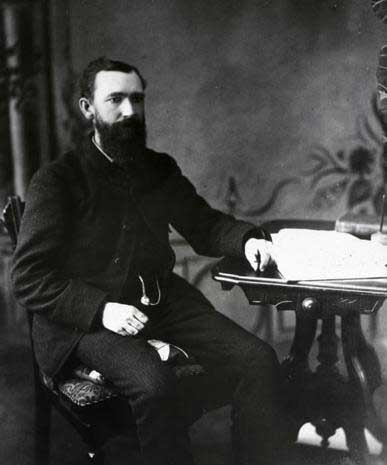
George Murdoch (1850 - 1910)
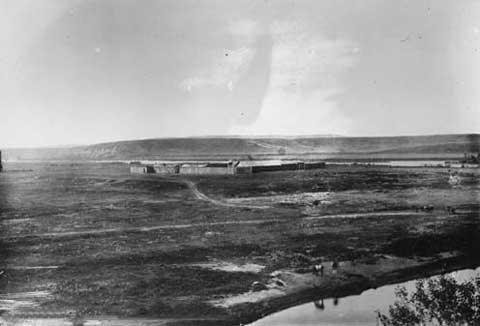
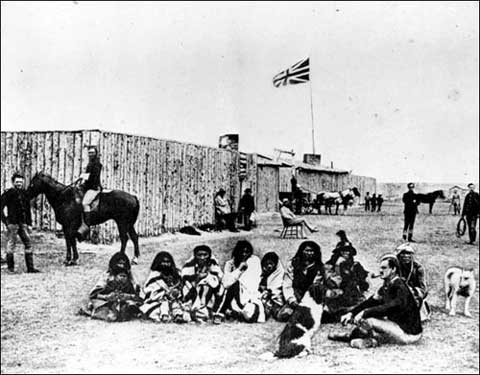
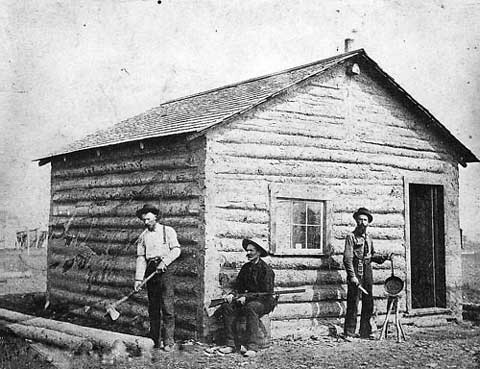
That's George on the right, outside his cabin in 1883.
George worked as a harness maker for the Mounted Police. The Blackfoot called him the Leather Man.
In 1884, he was elected the first mayor of Calgary. As its first magistrate, George sat on frontier trials. His diary (now in the Canadian Archives) describes a court case: "A strange sight, civilians, military, and Indians in paint looking in at the windows."
Lee's great-grandfather Edward Drinkwater was a Mountie from 1885 to 1909.

He was embroiled in the North-West Rebellion of 1885, a bloody uprising against the government by Metis and Cree.
The Battle of Fish Creek:


The Battle of Batoche:


"Write about what you know" is the mantra of all authors.
In his practice of criminal law from 1972 on, Slade defended and sometimes prosecuted over 1,000 trials involving the Mounted Police, including dozens of murders.
That's why Slade writes Mountie Noir.
By 1897, Queen Victoria had ruled for 60 years.

It could literally be said: "The sun never sets on the British Empire."

The Queen's Diamond Jubilee would see troops from every British colony and dominion converge on London, the heart of the greatest empire in history.
By far the largest swath of her realm was held by the Mounted Police.
To celebrate the departure the following day of the Mounties sailing to London, the force held a gala Red Serge Ball at its headquarters in Regina, Saskatchewan.
On receiving an urgent note, the commanding officer shut down the festivities: "The Police have other things to do besides dancing."
At 6 a.m. next morning, a train left HQ with reinforcements and a cannon, heading for the Duck Lake Indian Reserve.
The Last War Cry actually began 2 years earlier.
A 21-year-old Plains Cree named Almighty Voice was arrested by the Mounted Police for killing a settler's steer. That night, he escaped from custody and swam across the icy South Saskatchewan River.

A week later, Sergeant Colin Colebrook caught up with the fugitive.


As Colebrook approached on horseback, Almighty Voice, on foot, shot him through the neck with a double-barreled shotgun.
Colebrook tumbled to the ground dead.

Though a $500 reward was offered for Almighty Voice's arrest, it took the Mounties 19 months to corner him with 2 Native teens on a poplar bluff near Duck Lake.
Two officers got wounded, so the Mounties stormed the bluff.
In the ensuing shootout, Corporal Charles Hockin, Constable John Kerr, and the Duck Lake postmaster, Ernest Grundy, a former Mountie, fell dead.
Almighty Voice and the teens were still dug in.
That's the news that interrupted the Red Serge Ball.
Pax Britannica was the peace Britain imposed on its Empire.
In the 24-year existence of the Mounted Police, only 3 Mounties had been killed by Native Indians.
Now, less than a month before Queen Victoria's Jubilee, Almighty Voice had killed 3 more.
Soon 100 armed men and 2 cannons surrounded the bluff. After a bitterly cold night, the bombardment began.

Fifty high explosive shrapnel shells tore into the trees.
When the bluff was stormed to arrest survivors, Almighty Voice, his brother-in-law Tupean, and his cousin Standing-in-the-Sky were found blown to pieces.
Pax Britannica restored, the Queen's Jubilee Procession left Buckingham Palace.

And triumphant Mounties rode in the parade.

In Slade's world, however, 4 young Cree warriors occupied that bluff. And during the darkness before the shelling, Iron-child slipped away.
Much of the myth of the Mounted Police is American invention.
The Mounties' official motto is "Maintiens le Droit." "Uphold the Right." But many people think it's "The Mounties always get their man."
The origin of that iconic myth was an 1877 story in the Fort Benton, Montana, Record: "The Mounted Police are worse than bloodhounds when they scent the track of a smuggler, and they fetch their men every time."
By 1897, that unofficial motto had teeth, thanks to the relentless tracking skills of Inspector Wilfred Blake.
HEADHUNTER opens in the snowbound Rocky Mountains as the Mad Mountie closes in on his prey.

THE NIGHTMAREMedicine Lake, Alberta,1897
The body hung upside down from the ceilng by nails driven through both feet. The head was missing...
Meet Suzannah: HEADHUNTER's dominatrix.

The Mad Mountie's genetic insanity descends through a generation to the grasp of her whip.
EYES
New Orleans, Louisiana, 1957
Jazz was in the streets, and it wafted up on the warm night air, a musical mix of ragtime and bop and boogie-woogie and swing, drifting up over the heads of the Mardi Gras revelers snaking through the French Quarter...
What better window into the sexual underground of a city - any city - than to be "the hookers' lawyer?"
No sooner did Slade start defending trials in 1972 than Legal Aid sent him the first streetwalker charged under Canada's new prostitution law.
A new crime like "soliciting" is a lawyer's dream, since none of its defenses have been exposed by other lawyers.
It was easy to get the case tossed on a technicality, and because sex workers network to protect themselves against "bad dates," news of the win spread fast.
Armed with a new dragnet, the Vice Squad was busting prostitutes left and right, so almost overnight Slade became "the hookers' lawyer."
His first year of practice saw him defend 200 soliciting cases. Cocktail escorts charging big bucks in the fancy hotels. Junkies who'd do anything for the price of a cap of H. Street youths catering to curb-cruising homosexual men. Transvestites. Transsexuals...
And leather-clad dominatrices.

There's never a dull moment when you wallow in illicit sex.

In his 1st year of practice, Slade's name wasn't in the phonebook. However, the senior partner of a major corporate law firm shared the same last name. Soon, that lawyer's waiting room was inundated with scantly-clad escorts, junkies, and cross-dressers.
Slade got an icy phone call demanding he fix the problem.
"What do you want me to do?"
"Change your name," said the corporate lawyer.
Slade's client was incensed that an undercover detective had busted her by pulling up alongside her stroll in a farm truck full of manure.
"How was I supposed to know he was a cop?"
Outside the courtroom, Slade told the officer, "That was underhanded."
"No way," he replied. "I gave her a fighting chance. She should have guessed. The truck was full of pig shit."
In the early 1970s, sexual mores were loosening fast and obscenity laws were crumbling.

The Vice Squad overcharged a theater with showing an S&M film. It was actually bloodless B&D: bondage & domination.
After 2 years of adjournments, the case came on for trial. By then, the police station itself was surrounded by bare-all strip bars.
An exhibit screening took place in the inspector's office. The inspector's broom closet was more like it. Two detectives, 3 lawyers, and the projectionist were crammed in to watch a woman in panties hang from a ceiling beam and get whipped with a cat-o'-nine-tails.
Day in, day out, Slade faced the same vice cops. They needled him, so he needled them back.
"This is phony," Slade scoffed. "She's not tied. She's hanging onto the cord. That's not a whip. It's just satin ribbons. Where's the blood? The lash leaves no marks. If this is your idea of porn, you must have a dull sex life."
One does not impugn the virility of a vice cop. "You need sound for the full effect," the offended man snarled.
He cranked the projector's volume up to ear-bleed level. The on-screen woman let out a scream to wake the dead. An off-screen voice shouted, "Hit her again! Give her the whip! Rip the skin off her back!"
Suddenly, the inner door burst open. A burglary detective filled the frame. "What the hell's going on in here? We're trying to run a lineup!"
Behind him, 8 quaking B&E artists listened to what the cops were doing to some poor woman next door, and no doubt wondered if they were next.

Fox stole
Slade was building his new office, and work was behind schedule. He had to interview clients in a nearby coffee shop.
To speed things up, Slade helped paint. Roller in hand, speckled face, peaked cap, and overalls.
His secretary interrupted to announce: "Peter" - a longtime client - "is having a meltdown next door."
Still in painting gear, Slade entered the coffee shop. It was full of cabbies taking a break, and cops on shift change.
Dressed in drag, but obviously male and ugly to boot, Peter wore a cheap wig and consignment clothes wrapped in a ratty fox stole with the head and paws still attached. To mask his Nixon-like beard shadow, he'd caked on so much makeup that he looked like a cadaver.
Seated with him, a female junky had nodded off on his shoulder.
Nothing irks a transvestite more than being charged under his male name. No sooner did Slade sit down than Peter jumped to his feet, threw down a court summons, and shrieked at the top of his lungs: "I'm not a fag! I'm a lesbian!"
Every head in the coffee shop turned to glare at the propositioning painter and the hysterical he/she.
Then one of the cops got up and approached the table. It was the virility-impugned detective from the B&D screening.
"You're right, counsel," he smirked. "Your sex life is anything but dull."
And so it went. Never a dull moment. And Slade took full advantage of his research window into the sexual underground.
Of all his soliciting clients, he asked the same 2 questions:
"Who was your weirdest john?"
"And what was your deadliest encounter?"
Sex is nitroglycerin. Handled the wrong way, it can explode.
One of Slade's skid road clients later fell prey to Robert "Willie" Pickton, the West Coast pig farmer who confessed to butchering 49 sex workers.

The Mad Mountie's genetic insanity descends through Suzannah's New Orleans House of Pain to the next generation.
THE HIPPIE
On the Santiago River, Ecuador, 1969
"Wanta do some acid?"
"Huh?"
"LSD. Wanta do some?"...

Slade's first murder trial was horrific. The Mounties were called to an upcountry bus station where a man was standing on his head in a men's room urinal, shouting, "I'm Jesus Christ!"
For possessing a stolen car, the head-stander got three months in jail. Each morning, he would strip, defecate in his hand, then smear both himself and his cell. The jailers would hose him down and mop up.
One day, they found a torn-up "death warrant" floating on the floor: "The witch shall be burned at the stake, and all those who led her astray shall eat her ashes."
The note was ignored, and the prisoner was released.
On returning home, he peeked in through the kitchen window and watched his wife talk on the phone. Auditory hallucination told him she had a lover. In fact, she was talking to a female relative.
Grabbing a baseball bat, the psychotic man burst in and pulverized his wife.
Anti-psychotic drugs rendered him fit to stand trial. At one point, while Slade was advising his client in a small interview room, the man's eyes went vacant, as if he was no longer there. Then the room filled with a stench like rancid goat cheese.
The jury found him not guilty by reason of insanity, and the judge sent him to Riverside, Essondale's successor.
A week later, Slade drove out to say goodbye. On the way, he picked up a box of business cards. Then, while Slade was out of the room consulting with a psychiatrist, his client stole most of the cards.
Before he got back to the office, Slade's phone began ringing. Those acquitted by reason of insanity and those being assessed for fitness to stand trial were confined in the same hospital. Slade's client was busy handing out his business cards.
As a judge later put it injudiciously: "Counsel, it seems you've cornered the crazy market."

A Canadian volunteered to fight with the U.S. military in Vietnam. Armed with lots of LSD, he became a gunner in helicopter raids.
For combat, he stripped naked and donned a leather flying helmet from the First World War, fitted with a horse's bridle across his mouth.

Ripped on acid, he wrapped himself around the chopper's mounted machine gun so it extended from him like a huge mechanical penis. With the trigger hooked by the bridle, he threw back his head, and the ratatat-tat vibrations of the gun made him ejaculate.
Asked to explain himself, the soldier said, "We're here to fuck the Cong. That's what I'm doing." The military discharged him as unsuitable for warfare.
Back home, the washout was soon suspected of waylaying male backpackers in the bush. The police found bodies staked facedown over boulder humps. During sodomy, their skulls were smashed with rocks.
While talking with his client in a courthouse cell, Slade was struck by deja vu.
For the 2nd time in his law career, Slade saw his client's eyes go vacant, as if he was no longer there. Then the room filled with a stench like rancid goat cheese.
The human body oozes 3 kinds of sweat. The sweat of work. The sweat of fear. And the sweat of insanity.
Trans-3-methyl-2-hexenoic acid (TMHA) is the goatish stench of schizophrenia.

A French foreign legionnaire was sitting in the Sahara Desert when he felt a painful wrench inside his skull. He was seated sideways to the North and South Poles, and formed the delusion that a burst of polar energy had interacted with his front-to-back brain waves, causing his brain to jerk a quarter-turn around in his skull. With his brain's greater length now crammed into his skull's lesser width, the legionnaire was plagued by excruciating headaches.
Standing on the North Pole would, he believed, reverse the sideways alignment. So that's why he quit the Legion and flew to Canada.
There, he began to hear voices whispering through his apartment walls, conspiring to deport him before he could finance his Northern trek. In self-defense, he donned his French Foreign Legion combat fatigues and went on a shooting rampage, causing death.
By then, Slade specialized in the law of insanity, so the attorney general retained him to prosecute the case.
And so it went. In 1981, a recession induced the government to slash legal aid. To fill the downtime caused by curtailed court cases, the law partners of Clarke, Covell, Banks collaborated on writing a write-what-you-know-about police psycho-thriller.
HEADHUNTER was published in 1984.
The Headhunter is loose on the streets of Vancouver.
The victims are everywhere - floating in the Fraser River, buried in a shallow grave, nailed to an Indian totem pole on the university campus...

Here's an assortment of HEADHUNTER covers and reviews.

American edition
"HEADHUNTER stunned me. It's really good." - Alice Cooper
"A real chiller! The most gruesome I have ever read." - Robert Bloch (author of PSYCHO)

American edition
"WARNING: Not for the squeamish. A novel so terrifying it will haunt your dreams for weeks." - Book of the Month Club Magazine
"An encyclopedia of weirdness. There's enough assorted kinkiness, perversion, and psychosis in HEADHUNTER to fill a dozen insane asylums. The setting is refreshing, with real suspense and interesting characters." - Asbury Park Press

British edition
"Macabre. A very polished tale." - Sunday Telegraph, London

British edition
"Well written, well researched, and a gripper." - The Daily Mail, London

Canadian edition
"Full of spooky weird stuff, fast-paced shoot-em-up action, and a surprise ending. There are twists and turns, false leads and sudden shocks. You probably won't be able to figure out whodunit." - The Gazette, Montreal

German edition
"HEADHUNTER is undoubtedly the most chillingly impressive tome of its genre I've read in simply ages. I can assure you that the ending is a total surprise. Gruesomely mesmerizing, HEADHUNTER is compulsive reading." - Kerrang!

German edition
"Bizarre! Full of tension and mystery, with unforgettable scenes and weird happenings." - The Scotsman

French edition
"First rate, compelling, nerve-tingling. A novel of sex, death, and the macabre. Extraordinarily vivid. A thinking man's TEXAS CHAINSAW MASSACRE. It works exceptionally well. One of the novel's more noteworthy achievements is a complex structure of flashback sequences and parallel story lines, which allows Slade to artfully play the old genre game of posing various solutions to the identity of the killer." - The Vancouver Sun

French edition
"This clever whodunit has everything you'd expect to find in a good heart-stopper. It has more madness than the average psychiatrist is likely to see in a decade. The action explodes within the first few pages. Suspense of the best variety compels us to keep on going no matter how grisly the reading becomes, or how chilling the manner in which it's able to keep us hanging in a consistently dazzling way." - The Victoria Times-Colonist

French edition
"Awesome. A tour de force! A brilliant, shocking, bizarre story. Moves at a crackling pace. HEADHUNTER does for the mind what a roller coaster does for the body." - Australian Magazine

Japanese edition
"Compulsively readable through to the really shattering surprise ending." - Weekend Australian

Dutch edition
The story continues in GHOUL...